
8 Sustainable Finance
Overview of the Sustainability Finance Framework
HRR has formulated the Sustainability Finance Framework as a basic policy for sustainability finance, compliant with the Sustainability Bond Guidelines (SBG) 2021 and other principles and guidelines. The Japan Credit Rating Agency, Ltd. (JCR) has evaluated the appropriateness of the framework and assigned it JCR’s highest rating, "Overall Evaluation: SU1 (F)." Please see JCR’s evaluation report below.
[JCR’s Evaluation Report on Sustainability Finance Framework]
HRR conducts, evaluates, and manages sustainability finance based on this framework. It aims to provide ESG investment opportunities to a wide range of investors interested in sustainability.





Together with Hoshino Resorts Group, the Asset Management Company aims to realize a sustainable economy and society through the tourism industry, by not only addressing climate change, but also by making concrete contributions to society. In addition, all stakeholders in the value chain of the accommodation business related to HRR aim to achieve HRR’s ESG strategy, "Operations with CSV in mind," in the medium to long term, while cooperating and collaborating with each other for environmental conservation and social contribution. They have established goals such as the realization of an equal society in which all people can play an active role, the development of healthy and comfortable working environments, and contributing to regional revitalization and pushing forward with daily business activities. Based on this concept, HRR’s Sustainability Investment Policy for promoting and implementing solutions to environmental and social issues is as follows:
HRR believes that solutions to climate change and social issues are interrelated, albeit to varying degrees. The Asset Management Company clarifies the risks of climate change and social issues and responds to climate change to achieve a reduction in GHG emissions by hotels and implements initiatives to increase disaster resilience. HRR also recognizes that the preservation and utilization of the history and cultural value of the area in which the hotel is located, as well as the revitalization of industry, are related to “travel”, namely the quality of tourism resources.
Further, HRR believes that the role of hotels in areas where residents live is to provide solutions so that the entire community can achieve wellbeing and produce output that contributes to the circulation of the local economy, such as an increase in population, and that it is important to achieve an outcome of updated markets and community composition as a result of efforts to resolve these issues.
At the same time, in addition to taking measures for real estate, it is also necessary to stockpile emergency supplies and conduct training on a daily basis so that hotels can be used as evacuation centers in the event of disasters caused by heavy rain or rising temperatures due to climate change.
In accordance with the above Sustainability Investment Policy and the Sustainability Policy, the Asset Management Company will carry out appropriate asset management by thorough implementation of risk management and compliance.
1. HRR’s awareness of environmental and social issues
HRR summarizes environmental and social issues that have a large impact on the tourism industry as follows:
In setting "Issues to be resolved," constraints for climate change are the achievement of the CO2 emission reduction target for 2030 and realization of carbon neutrality by 2050, and for social issues, the constraints are the revitalization of local industries and linking the economy to tourism. With these constraints, we have considered concrete action guidelines in terms of both hard and soft aspects that are easy to understand for those involved in accommodation facilities or real estate and that can be used to mobilize collective efforts to produce results.
This table can be scrolled sideways.
| Climate change | Social issues | |
|---|---|---|
| HRR’s risks |
Climate change risk
|
Social risk
|
| Issues to be resolved |
|
|
The role of accommodation facilities in the region and the concept of circulation (conceptual diagram)
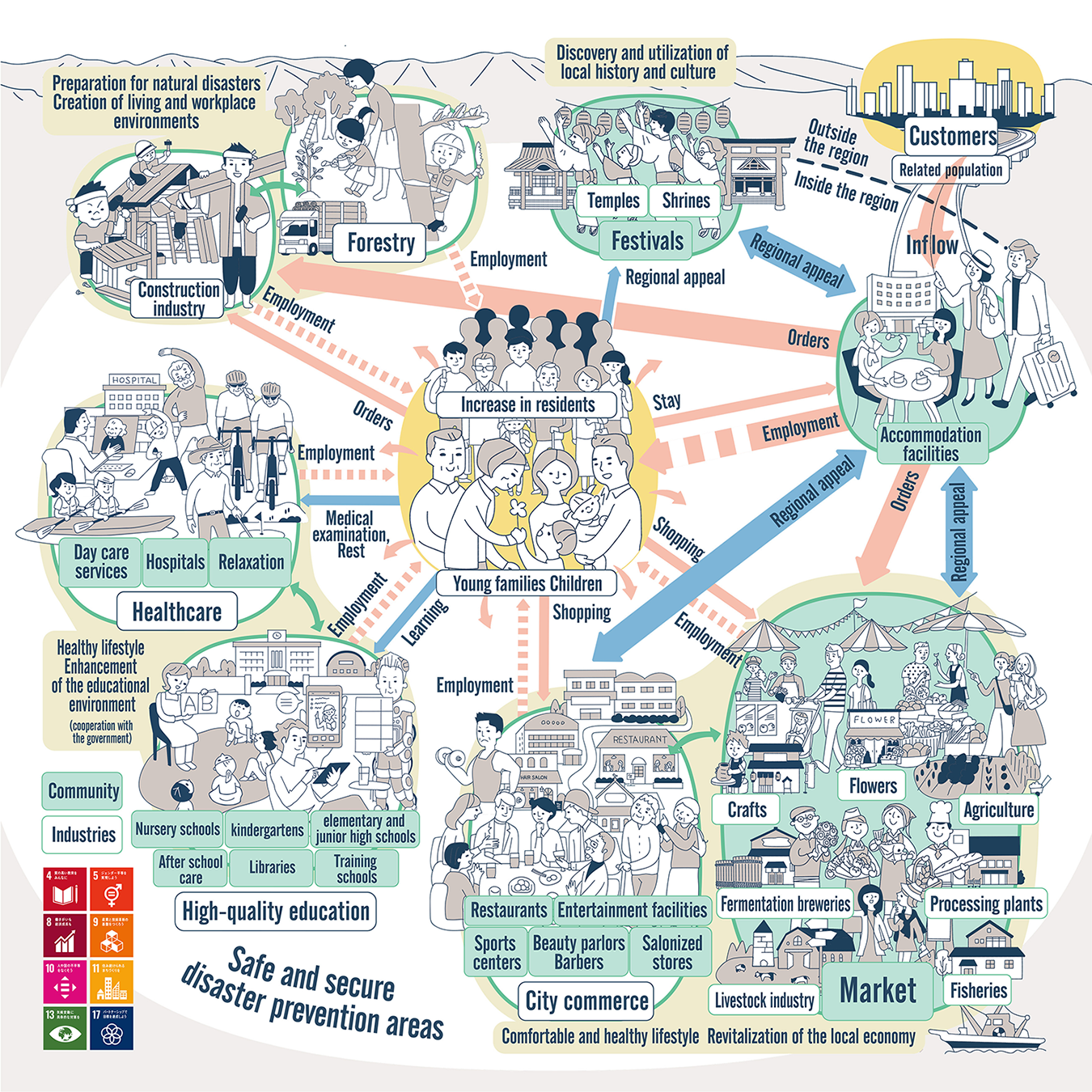
- The above diagram is a conceptual diagram prepared by the Asset Management Company for the purpose of communicating HRR’s Sustainability Investment Policy, etc. in an easy-to-understand manner, and does not guarantee the accuracy or realization of the content.
2. Use of procured funds
HRR plans to use the proceeds raised through sustainability finance to acquire assets that meet the following social eligibility criteria and green eligibility criteria (hereinafter collectively "Eligibility criteria") or to refinance the funds.
3. Eligibility criteria
[Social eligibility criteria]
HRR, the Asset Management Company, the lessee, or the operator shall, for the target property, implement two or more of the following “Initiatives for related parties, including users of real estate”, and two or more of the “ Initiatives for local communities” (however, at least one of 1 through 4 shall be included). If the property falls under the Green eligibility criteria “(3) Renewable energy” described below, the social beneficial impacts of the property on which the relevant asset is to be installed shall apply mutatis mutandis.
The numbers shown in "Social issues" and "Stages of social issues" in the following table are in accordance with the "Interim Summary of the ESG Investment Promotion Study Group Addressing Social Issues in the Real Estate Sector" (the Ministry of Land, Infrastructure, Transport and Tourism). Please refer to the following document.
[The ESG Investment Promotion Study Group Addressing Social Issues in the Real Estate Sector (the Ministry of Land, Infrastructure, Transport and Tourism) ](Only available in Japanese)
< Initiatives for related parties, including users of real estate >
*Related parties, including users of real estate: tenants, employees, residents, visitors, workers engaged in real estate development, etc.
This table can be scrolled sideways.
| Social issues | Stages of social issues | Output | Outcome | Impact | |
|---|---|---|---|---|---|
| 1 | Healthy living and workstyle | ①, ②, ③ | Implementation of “Ease of Work Survey” related to society and wellness |
|
Improvement of health and comfort |
| 2 | Comfort of the workplace environment | ①, ② | Publication of the Sustainability Guide | Voluntary action on climate change and social issues | Raising awareness of environmental and social issues |
| 3 | Preparation for natural disasters | ① | Implementation of regular building safety management checks, disaster drills, stockpiling of emergency supplies, food, medicine, etc. | Disaster preparedness and training | To protect people's lives and livelihoods |
| 4 | Preparation for natural disasters | ① | Analysis of portfolio resistance (resilience) from historical disaster data | Understanding current circumstances to apply past lessons to disaster prevention | To protect people's lives and livelihoods |
| 5 | Realization of diverse work styles and improved productivity | ③ | Promoting the use of internship programs, intra-group personnel exchange programs, training programs for new graduates, career development programs, and professional development programs | Early development of high-quality human resources and formation of career vision | To exercise one's motivation and ability |
< Initiatives for local communities >
This table can be scrolled sideways.
| Social issues | Stages of social issues | Output | Outcome | Impact | |
|---|---|---|---|---|---|
| 1 | Local charm and rich economy | ③, ④ | To explore local industry and history, and provide guests with more appeal for their stay | Revitalization of the culture of festivals and other events, secondary industries such as processed foods, and primary industries such as agriculture |
|
| 2 | Local charm and rich economy | ③, ④ | Plans to develop hot spring areas and install commercial facilities, etc. |
|
|
| 3 | Prosperous economy | ③ |
|
|
|
| 4 | To protect people's lives and livelihoods | ①, ② | Providing shelters (places and food) | Protection of stranded commuters and local residents |
|
| 5 | Dignity is preserved | ① | Providing low-cost hotels | Realization of a simple and comfortable stay | Realization of an inclusive society |
| 6 | Dignity is preserved | ① | Prevention of pandemics and establishment of patient care facilities | Prevention of infectious diseases | Reduction in the number of infected people and strain on hospital beds |
| 7 | Healthy living and local charm | ②, ④ |
|
|
|
[Green eligibility criteria]
This table can be scrolled sideways.
| (1) Green building and additional initiatives contributing to the environment |
Properties which have acquired or are scheduled to acquire certifications from third-party certification authorities by satisfying criteria ① to ④ below. If the additional initiatives specified in (i) to (v) are implemented for ① to ④, the entire property shall be considered a Green Eligible Property.
<Additional Initiatives>
|
|---|---|
| (2) Pollution Prevention and Management | Properties that have achieved a 100% recycling rate for waste. |
| (3) Renewable energy | Acquisition or installation of renewable energy power generation facilities. |
| (4) Energy Efficiency | Costs related to the introduction of energy-saving equipment, such as updating air conditioning systems, converting lighting fixtures to LED, or installing energy storage systems (with a projected reduction in usage or emissions of 30% or more compared to traditional methods). |
| (5) Renovation Works | Renovation works related to owned assets that enable beneficial environmental improvements, such as reductions in CO2, energy, water usage, or emissions (with a projected reduction in usage or emissions of 30% or more compared to traditional methods). |
4. Project evaluation and selection process
Projects that meet the eligibility criteria for the use of funds procured through sustainability financing are selected by the Chief Sustainability Officer (CSuO) and are evaluated and discussed by the ESG Committee, which is composed of the President & CEO of the Asset Management Company, the Chief Investment Officer, the CFO, the Chief Strategy Officer (CSO), the Compliance Officer, and the CSO. Following these evaluations and discussions, projects are decided on by the Board of Directors of the Asset Management Company and reported to the Board of Directors of HRR.
- The names of departments and positions are listed according to the current company structure.
5. Management of procured funds
After funds are procured through sustainability financing(interest rate derivative contracts associated with the loan, known as sustainability derivatives) and deposited into an account, they are allocated without delay as funding for assets that meet the eligibility criteria or to refinance loans required to acquire asset which meet the eligibility criteria.
The Asset Management Company manages the allocation status of procured funds using internal electronic files and other media. It reports to its Board of Directors and HRR’s Board of Directors as necessary. Furthermore, internal audits are conducted by the Compliance Department and an audit corporation.
Procured funds that have yet to be allocated are managed in the form of cash or cash equivalents until their allocation. Even after all funds are allocated, if funds are no longer to be used for assets due to the sale or impairment, etc., of those assets before the redemption of the bonds subject to evaluation or the final repayment date of borrowings, the unallocated funds that temporarily arise are managed using portfolio management*.
- Portfolio management is a management method used to confirm that the sustainability finance balance at each accounting period does not exceed the maximum amount of sustainability eligible liabilities [total value of assets (acquisition price) for assets (properties) that satisfy social and green eligibility criteria (1) to (2) × LTV + total amount of money allocated to green eligibility criteria (3) to (5)].
6. Reporting
(1) Method and frequency of disclosing the status of fund allocation
Each HRR accounting period, the following information is disclosed on its website.
- Any fund allocation plans for unallocated funds at the time of procurement through sustainability financing
- If assets for which funds are to be used are sold before the repayment date of procured funds, the fact that the balance is being managed using portfolio management, the sustainability finance balance, and the maximum amount of sustainability eligible liabilities
(2) Method and frequency of disclosing impact reporting
Every year, the Key Performance Indicators (KPIs) shown in (3) below are disclosed on HRR’s website only as applicable.
(3) KPIs in impact reporting
[Impact reporting related to social projects]
This table can be scrolled sideways.
|
Output (Results of initiatives for each property) |
The name and overview of the property acquired will be disclosed on HRR’s website |
|---|---|
|
Outcome (Social and environmental changes and benefits brought about by the output) |
|
|
Impact (Social effects (targets) aimed at by realizing outcomes, including short- and long-term changes) |
|
[Impact reporting related to green projects]
- Number and type of environmental certifications for acquisition assets
- Energy-saving effects from the replacement of air conditioning equipment, etc
- (For renovation work) Energy and water usage amounts before and after renovation
- (For renewable energy projects) Annual power generation and (estimated) CO2 reductions for the power generation equipment for which funds were allocated
- Annual power generated by EIMY (hydroelectric power, etc.)
- Amount of environmentally-friendly energy other than EIMY power that was procured
- Ongoing composting of food waste (from 2011)
-
Reduction in amount of plastic container usage
- ① Ongoing switchover to use of pump bottles for shampoo, conditioner, and body soap (from 2019)
- ② Gradual switchover from mineral water in plastic drink bottles
- Number of toothbrushes recycled
- Overview of Nature Conservation Activities
- Overview of Recycled waste
Reporting based on the Sustainability Finance Framework
(1) List of sustainability-qualified assets (As of April 30, 2026)
サステナビリティ適格資産一覧非表示時test
This table can be scrolled sideways.
| Green Building Certification(※1)(※2) | Property name | Acquisition Price (million yen)(※4) |
|---|---|---|
| BELS(※3) | ||
| ★★★★★ | HOSHINOYA Okinawa | 12,210 |
| KAI Kaga | 3,160 | |
| ★★★★ | Iriomote Hotel (Hotel building) | 3,650 |
| - | Total | 19,020 |
- The scope of evaluation for BELS certification may be only for part of the property. However, the total acquisition price for each property is used as the acquisition price.
- In cases where multiple buildings within the property were granted BELS certification or CASBEE certification, the highest rating awarded to the relevant property is used.
- With the revision and enforcement of the notification for the Buildings Energy-efficiency Labelling system in April 2024, the energy conservation performance labelling has become a seven-step system, but the ratings here are based on the five steps under the previous system.
- Amounts are rounded down to the nearest unit.
(Reference)
Due to changes in the framework following the revision and enforcement of the notification for the Buildings Energy-efficiency Labelling system in April 2024, some properties do not qualify as sustainability-qualified assets and are not included in the list of properties below.
This table can be scrolled sideways.
| Green Building Certification(※1)(※2) | Property name | Acquisition Price (million yen)(※4) |
|---|---|---|
| ★★★ | HOSHINOYA Taketomi Island | 4,955 |
| ★★ | KAI Tamatsukuri | 680 |
(2) Reporting on the status of fund allocation (As of April 30, 2026)
サステナビリティ充当状況test
- There are no unallocated funds at the time of procurement through sustainability equity.
- There has been no sale of assets that are subject to the use of funds.
Sustainability finance balance and maximum amount of sustainability eligible liabilities (portfolio management)

- LTV is based on the ratio of interest-bearing liabilities as of April 30, 2026 to the total acquisition price of properties owned by HRR.
- Monetary amounts are rounded down to the nearest unit and ratios are rounded to the nearest unit.
| Maximum amount of sustainability eligible liabilities (million yen) | Sustainability finance balance (million yen) | |
|---|---|---|
| 8,540 | ≧ | 400 |
- The sustainability finance balance does not exceed the maximum amount of sustainability eligible liabilities.
(3) Impact Reporting (As of April 30, 2026)
[Impact reporting related to social projects]
The outputs that are implemented in the assets owned by HRR that satisfy the eligibility criteria are indicated below.
As of April 30, 2026
This table can be scrolled sideways.
| Property name | Initiatives related to real estate users or other relevant parties (output) | Initiatives related to the local community (output) |
|---|---|---|
 HOSHINOYA Okinawa |
|
|
 KAI Kaga |
|
|
 Iriomote Hotel |
|
|
[Impact reporting related to green projects]
Information is disclosed only for properties owned by HRR that satisfy the eligibility criteria defined in the Sustainability Finance Framework, that are in the possession of HRR for the entire year, and for which data regarding individual reporting items can be collected.
Number and type of environmental certifications for acquisition assets
See the [External evaluations of sustainability] for details.
Energy-saving effects from the replacement of air conditioning equipment, etc
There are no funding procurements through sustainability finance targeting the replacement of air conditioning equipment and other related systems.
(For renovation work) Energy and water usage amounts before and after renovation
There are no funding procurements through sustainability finance targeting renovation work.
(For renewable energy projects) Annual power generation and (estimated) CO2 reductions for the power generation facilities for which funds were allocated
There has been no fund procurement through sustainability finance for renewable energy.
Annual power produced by EIMY (utilization of hydroelectric power, etc.)
There has been no procurement of natural energy through EIMY in properties that are subject to sustainability finance.
Amount of environmentally-friendly energy other than EIMY power that was procured
There has been no procurement of natural energy through measures other than EIMY in properties that are subject to sustainability finance.
Ongoing composting of food waste
There has been no composting of food waste in properties that are subject to sustainability finance.
Reduction of plastic container usage
(1) Ongoing switchover to use of pump bottles for shampoo, conditioner, and body soap
Pump bottles are being used for shampoo, conditioner and body soap at the following three properties.
(2) Gradual switchover from mineral water in plastic drink bottles
In order to reduce their environmental impact, plastic bottles of mineral water are not being provided to guests at the following three properties.
Number of toothbrushes recycled
FY2025 RESULTS OF TOOTHBRUSH RECYCLING

- Figures are tabulated figures (approximate estimates) for one-year period from April of each year to March of the following year.
Overview of Nature Conservation Activities
Please refer to the following pages.
[Contribution to the local community and economy]
Overview of Recycled waste
There are no applicable properties.