
1 Sustainability Management
Recognition of Risks and Opportunities
Our Perspective on Climate Change and Strategic Direction
We recognize that the progression of climate change will bring about serious and irreversible changes to the natural environment, social structure, and the lives of humans and other living creatures, and that it is an important issue that will have a significant impact on the asset management and corporate value of HRR.
Therefore, we believe that a “strategic decarbonization” approach, in which business strategy, investment decisions, and capital allocation are revised in an integrated manner, will be essential to reduce the impact of climate change and to continue long-term sustainable investment and asset management activities.
HRR aims to reduce greenhouse gas (GHG) emissions by at least 40% by 2030 compared with 2020, with a view to achieving net zero emissions by 2050. This goal is predicated on the transition to a low-carbon economy, and we aim to achieve it through a reconfiguration of portfolio strategies, capital expenditures, planning, and improvement and repair policies. Specifically, we will develop an asset management policy that focuses on avoiding stranded asset risk and brown discounts, improving energy efficiency, deploying renewable energy as needed, and strengthening resilience.
CO₂ accumulated from the massive consumption of fossil fuels since the Industrial Revolution has caused global climate change. In response to this profound environmental change, HRR is promoting a multifaceted approach, including science-based GHG reduction, long-term preservation of asset values, revitalization of local economies, and coexistence with ecosystems, in addition to the utilization of technology.
Roadmap to Net Zero
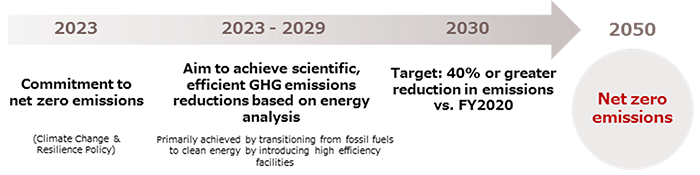
HRR's Climate Change Roadmap organizes and presents our direction in relation to capital allocation, risk management, and emissions reductions for decarbonization over a medium to long-term time horizon. This Roadmap was designed to adhere to the CDP framework. Although the CDP score itself is not publicly available, we ensure that our disclosures are aligned with CDP Assessment framework Level M3.
To achieve the goals outlined in the Roadmap—reducing GHG emissions at least 40% by 2030 toward net-zero in 2050—we have also established five-year performance improvement targets for each property regarding the reduction of energy and GHG emissions. Specifically, we are implementing improvement measures tailored to the conditions of each property through efficient capital investments and operational enhancements based on energy analysis. Under the Asset Management Company’s water conservation policy, we are pursuing a long-term goal of reducing annual water consumption by 1% from the baseline level. We will monitor and disclose the progress of these initiatives every year, striving to improve environmental performance and construct an environmentally-friendly portfolio.
Endorsement of TCFD Recommendations
HRAM endorses the recommendations of the Task Force on Climate-related Financial Disclosures (TCFD), and makes disclosures in accordance with the recommendations.
In addition, we are continuously working to enhance the content of disclosures and management methods, in order to appropriately identify risks and opportunities related to climate change and reflect them in investment decisions and capital allocation.

Governance System for Addressing Climate Change
HRAM positions our response to climate change as an important management issue, and HRAM’s Board of Directors works to formulate related policies and oversee progress.
In execution, the “ESG Committee,” which is responsible for addressing sustainability issues, has been established to examine and make proposals related to energy efficiency and decarbonization.
In addition, we have established a “Climate Change and Resilience Policy” as our policy for responding to climate-related risks and opportunities, and this policy is reflected in our decision-making, under a structure in which the President & CEO holds overall responsibility, and the Chief Sustainability Officer (CSO) is responsible for execution.
Sustainability Policy
Governance
Implementation of Scenario Analysis
In order to understand the risks and opportunities that climate change poses to HRR and to examine the impact on our businesses, HRAM analyzes both hotel operations and real estate investment and management, and conducts scenario analysis based on the following two climate scenarios.
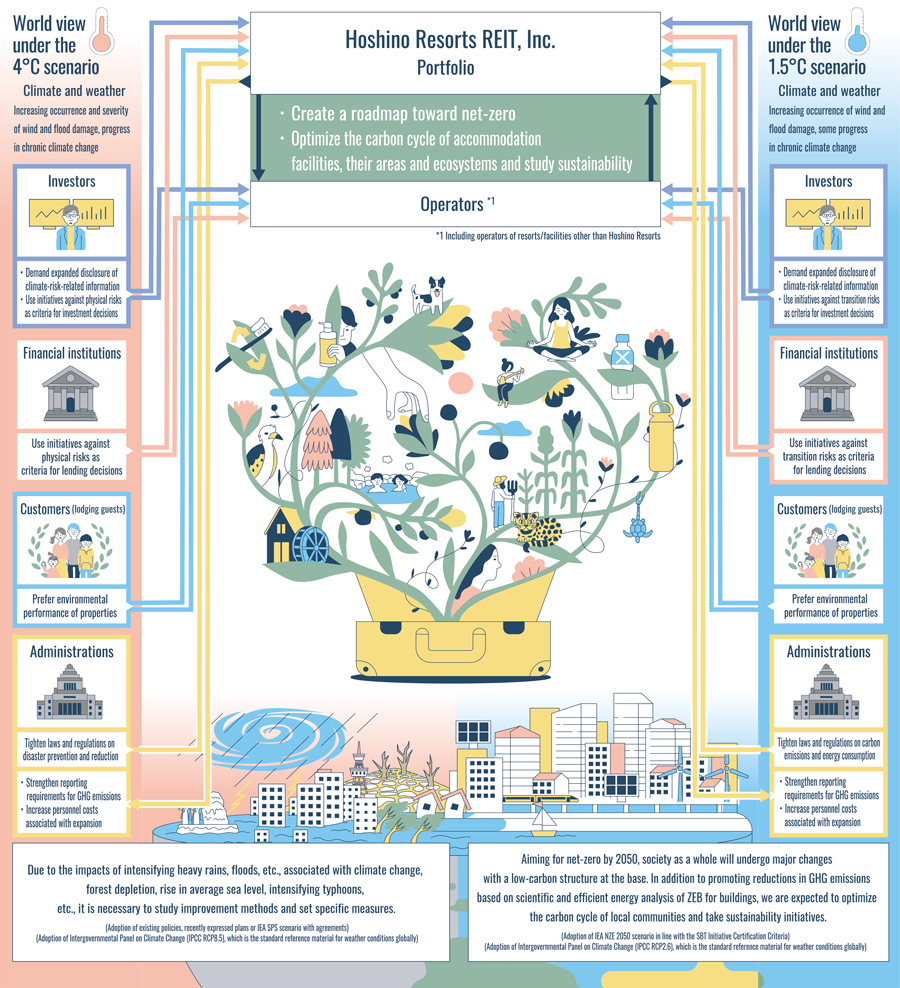
Verification of Financial Impact Based on Scenario Analysis
Based on the findings of this analysis, we create an order of priority for disaster resistance improvement measures for areas with high disaster risk and existing properties, and we are reflecting it in a phased enhancement plan.
Scenario Analysis Table
| Financial Impact under 4°C scenario | Financial Impact under 1.5°C scenario | ||||||||||
|---|---|---|---|---|---|---|---|---|---|---|---|
| Risks and Opportunities | Potential Financial Impacts | Risk Management, Reponses and Initiatives |
Short Term |
Medium Term |
Long Term |
Short Term |
Medium Term |
Long Term |
|||
| Transition Risks and Opportunities | Policy and Law | Risk | The introduction and enhancement of carbon pricing and rising energy prices may increase operating costs, while differences in environmental performance may affect asset competitiveness and investment payback periods. | ・ Increase in utilities and operating expenses ・ Impact on occupancy rates and rent levels due to differences in environmental performance ・ Pressure on cap rates and asset values due to emphasis on environmental performance as a market valuation standard ・ Longer investment payback period ・ The impact may become apparent over the medium to long term, owing to stricter regulations and the gradual upgrading of market valuation standards |
・ Absorption of carbon cost increases through the systematic implementation of energy efficiency improvements (LEDs, air conditioning upgrades, BEMS introduction) ・ Check energy performance and facility renewability (ease of renewal) at the time of property acquisition to avoid brown discounts ・ Improve the quality of investment decisions by utilizing internal carbon price (ICP) estimation for cost-effectiveness analysis of energy efficiency improvements and repairs |
Small | Medium | Medium | Small | Medium | Large |
| Risk | Increased costs for improvements, repairs, etc., due to the Energy Conservation Act and the advancement of building energy efficiency standards | ・ Increased costs for improvements and repairs, as well as reporting, are expected owing to the shift toward mandatory compliance improvements and repairs and increased notifications ・ Existing buildings that fail to meet standards face the risk of declining asset values (brown discounts) |
・ Investment decisions incorporate regulatory compliance costs in pre-acquisition due diligence ・ For existing properties, priority is given to facility renewals where it will be “easy to comply with regulations,” such as lighting and air conditioning, to limit compliance risk ・ Proactively acquire building performance certifications such as ZEB Ready/Oriented to avoid long-term value loss |
Small | Small | Small | Small | Medium | Large | ||
| Risk | The presence of European investors may indirectly influence sustainability-related legislation and disclosure requirements in Europe through their investment decisions | ・ Risk of being excluded from investors’ investments if we fall behind on disclosure standards ・ Increased operating costs for disclosure enhancement and data collection |
・ Continuing enhancing disclosure in alignment with TCFD/TNFD and anticipate investor demand ・ Establishment of ESG data collection and management system by ESG Committee, and gradual expansion of supply chain surveys ・ Assess ESG performance (environmental certification and conformance) of acquired properties to ensure capital market confidence |
Small | Small | Small | Small | Medium | Medium | ||
| Technology | Risk | Risk that delays in responding to more sophisticated assessment standards for environmental performance (ZEB Ready/Oriented, etc.) will affect asset valuation and capital costs | ・ Brown discounts due to the failure to meet standards (decline in valuation of properties with low performance) ・ Increase in improvement and repair expenses ・ Risk of reduced access to capital from investors (especially those with ESG requirements) due to lack of certification ・ The impact may become apparent over the medium to long term, owing to the gradual upgrading of market valuation standards |
・ Use pre-acquisition due diligence to confirm and assess environmental performance ・ Create an order of priority concerning energy efficiency improvements and repairs and facility renewals ・ Assess medium- to long-term life cycle cost (LCC) and GHG reduction effects together |
Small | Small | Small | Small | Medium | Medium | |
| Risk | Risk of increased costs for renewing, repairing, and improving facilities as technical standards become more sophisticated and facility specifications are updated | ・ Increased cost of compliance with high-efficiency air-conditioning, insulation, and renewable energy specifications ・ Impact on revenues and expenses from increase in improvement, repair, and renewal work ・ Risk of reduced attractiveness and competitiveness due to unfulfilled requirements (risk of becoming brown assets) ・ A moderate impact is possible over the short-term (up to five years) as gradual cost increases may become apparent as facilities reach their time for renewal |
・ Check energy efficiency performance with due diligence at the time of new acquisition ・ Reflect the order of priority of energy efficiency and renewable energy measures in improvement and repair plans ・ Evaluate LCC (operating cost reduction) when making investment decisions |
Small | Small | Small | Medium | Medium | Medium | ||
| Opportunities | Stabilization of operations and reduction of operating costs through high-efficiency facilities and renewable energy measures | ・ Reduction of utility expenses through high-efficiency facilities ・ Control increases in costs from rapidly rising energy prices ・ Potential to improve guest preference and occupancy rates by improving environmental performance |
・ Quantify utility expenses and GHG reductions and assess medium- to long-term recoverability ・ Introduce renewable energy, etc. (e.g., solar power, air-conditioning upgrades) in accordance with property characteristics ・ Operation of efficiency improvements in cooperation with hotel operators (to the extent possible) |
Small | Small | Small | Small | Medium | Medium | ||
| Markets and Opportunities | Risk | Risk of impact on asset valuations and cost of capital from differences in environmental performance and ESG ratings | ・ Properties with low environmental performance may be discounted in market valuations, resulting in a relative decline in asset value ・ A decline in ESG ratings or external ratings could lead to a deterioration in capital funding conditions or an increase in the cost of capital ・ Impact on future sale price |
・ Confirm environmental performance and ESG requirements in due diligence at the time of acquisition ・ Establish medium- to long-term plans for energy efficiency improvement and repairs and environmental certification acquisition ・ Continue enhancing disclosure in alignment with TCFD/TNFD and proactively address investor expectations. ・ Regularly check progress on ESG targets and take remedial action as necessary |
Small | Small | Medium | Small | Medium | Large | |
| Risk | Risk of rising energy prices and improvement and repair-related costs (cost pressure) in line with the acceleration of a response to decarbonization transition | ・ Higher operating expenses and pressure on NOI due to higher electricity and fuel prices ・ Increase in improvement and repair costs due to tight supply and demand for high-efficiency facilities, environmentally friendly building materials, etc., in response to decarbonization ・ Increase in cash outflows due to concentration of the timing of renewals, improvements, and repairs |
・ Renew facilities to high-efficiency facilities and promote measures to reduce energy use ・ Implement improvements and repairs in stages based on medium- to long-term repair plans ・ Examine procurement methods, including renewable energy procurement methods (PPA, etc.) ・ Mitigate the risk of price fluctuations by securing multiple procurement routes and standardizing specifications |
Medium | Medium | Medium | Small | Medium | Large | ||
| Risk | Risk of occupancy rate and profitability decline due to shift in demand toward a preference for low-carbon and change in brand reputation | ・ Possibility of a decline in occupancy rates and unit prices owing to changes in accommodation demand preferences if our response to environmental considerations is delayed ・ Medium- to long-term deterioration of profitability owing to a decline in brand reputation |
・ Promote energy efficiency performance improvements and environmentally friendly operations ・ Establishment of environmental performance standards during development and acquisition ・ Visualization of efforts and enhanced communication with stakeholders ・ Medium- to long-term management through Scope 1-3 identification, ICP examination, etc. |
Small | Small | Medium | Small | Medium | Medium | ||
| Opportunities | Opportunities to create accommodation demand and increase asset value by leveraging environmental and regional value | ・ Increase in occupancy rate and ADR due to increased demand for environmentally friendly accommodation and green tourism ・ Enhance brand value by strengthening efforts to address climate and regional issues ・ Improve capital market valuations and reduce the cost of capital by improving ESG assessments and linking impact with investing ・ Medium- to long-term increase in property values |
・ Promote and visualize energy efficiency and decarbonization measures ・ Development of accommodation programs utilizing local resources ・ Enhance ESG disclosure and implement impact assessments ・ Strengthen ties with local communities and investors |
Small | Small | Medium | Small | Medium | Medium | ||
| Physical Risks and Opportunities | Acute | Risk | Decrease in revenues due to flooding and wind damage caused by typhoons, torrential rain, etc., as well as operational suspensions | ・ Increase in repair and equipment replacement expenses due to flooding and wind damage ・ BCP costs associated with emergency relocation and improvement and repairs to avoid the flooding of important facilities ・ Increase in insurance premiums due to more severe natural disasters, and increase in effective burden owing to an expansion in deductibles ・ Decrease in sales due to facility closure and reduced operation (longer recovery periods after disasters) |
・ Establish priorities for the relocation of critical facilities to upper floors and waterproofing measures based on flood hazard information ・ Update business continuity plans and conduct drills that incorporate natural disaster risks for each property ・ Review our long-term holding policy in high-risk areas and prioritize the allocation of investments to improve risk tolerance ・ Expand asset size and diversify portfolio ・ Conduct surveys of large properties (13 properties) |
Medium | Medium | Large | Medium | Medium | Medium |
| Risk | Occurrence of large earthquakes (directly under the Tokyo metropolitan area, Nankai Trough) or volcanic eruptions (Mt. Fuji, Mt. Asama, etc.) | ・ Repair expenses ・ Decrease in occupancy ・ Decrease in customers ・ Reduction in asset values |
・ Planning for enhancing resilience after portfolio diversification and gathering the necessary data to prevent damage ・ Seismic reinforcement of properties when necessary |
Large | Large | Large | Large | Large | Large | ||
| Chronic | Risk | Constant flooding risk to coastal assets due to sea level rises, storm surges, etc. | ・ Increased risk of flooding due to sea level rises and more frequent storm surges may require additional investment in disaster prevention, raising embankments, waterproofing, etc. ・ Increase in effective burden due to higher insurance premiums and stricter deductibles ・ Damage to asset values and long-term profitability decline |
・ Periodic checks of hazard maps and past flooding history ・ Establish priorities for embankment raises, watertight panels, waterproofing repairs and improvements, etc., in coastal properties ・ Review long-term holding policies and strengthen location risk assessments at the time of acquisition ・ Periodic reviews of insurance terms and conditions and construction of risk-diversified portfolios |
Small | Medium | Large | Small | Small | Medium | |
| Risk | Fluctuations in tourism resources and seasonal demand due to rising temperatures and changing weather patterns | ・ Decreased snowfall, frequent heat waves, changes in the landscape and natural environment, and other factors may result in fluctuations in the value of local tourism resources ・ Fluctuations in occupancy rates and average spend per customer due to uneven seasonal demand and changes in the value of stays ・ Additional investment for alternative content development and value-added enhancements at facilities |
・ Improvement of regional demand forecasting based on climate change impacts ・ Enhancement of all-weather activities and value-added enhancements at facilities ・ Promote heat countermeasures through high-efficiency air conditioning and insulation improvements and repairs ・ Preserve and redesign tourism resources through collaboration with local governments and tourism operators |
Small | Medium | Large | Small | Medium | Medium | ||
| Risk | Risk of water resource constraints (water stress) associated with climate change | ・ Increase in water procurement costs due to changes in precipitation patterns and increased frequency of droughts ・ Additional investment in well water, water storage facilities, etc. ・ Decrease in sales due to temporary business restrictions and lower service level caused by water supply restrictions, etc. |
・ Secure multiple water sources such as well water, recycled water, rainwater utilization, etc. ・ Install water-saving equipment and monitor usage ・ Improve operations, such as peak time dispersion, etc. ・ Cooperate with regional water resource management and develop systems to secure BCP water |
Small | Medium | Large | Small | Small | Medium | ||
| Opportunities | Stabilize asset values and improve operational efficiency through investment in resilience and adaptation | ・ Reduce losses and operational burdens caused by extreme weather, rising temperatures, and water constraints ・ Maintain asset value by improving assessments of business continuity in the event of a disaster ・ Stabilize cash flows over the medium to long term ・ Possibility of improving insurance conditions and capital market valuation |
・ Incorporate water resistance, wind resistance, thermal insulation, and high efficiency of facilities into evaluation indicators when acquiring or improving and repairing properties, and reflect these factors in investment decisions ・ Improve long-term repair planning based on hazard information and climate scenarios ・ Install high-efficiency air-conditioning, hot water supply, heat insulation, and water-saving facilities in a planned manner ・ Strengthen operational stability by monitoring water use and securing multiple water sources ・ Disclose resilience improvement measures to investors and insurers to increase valuations |
Small | Medium | Medium | Small | Medium | Medium | ||
| Opportunities | Business opportunities to capture revaluations of natural capital and location values under climate change | ・ Differentiation utilizing natural environments and locations that will increase in relative value as a result of climate change ・ Capture long-term stay and high value-added demand ・ Increase average spend and profitability through brand value enhancement ・ Medium- to long-term increase in asset values |
・ Conduct site assessments based on changes in the local environment and landscape due to climate change ・ Periodically assess dependence on and the sustainability of natural capital (forests, water, ecosystems) ・ Promote design and product development that takes advantage of natural topography, vegetation, and water systems ・ Participate in nature conservation and restoration projects in cooperation with local governments, businesses, and NPOs ・ Visualize environmental value and appropriately disseminate information to customers and investors |
Small | Medium | Medium | Small | Medium | Medium | ||
- The following climate scenarios are referenced in this analysis.
1.5°C Scenario
(Transition risks) IEA NZE 2050 Scenario
(Physical risks) IPCC SSP1-2.6 Scenario
4°C Scenario
(Transition risks) IEA STEPS Scenario
(Physical risks) IPCC SSP5-8.5 Scenario
* IEA: International Energy Agency
* IPCC: Intergovernmental Panel on Climate Change - Financial impacts for each scenario are assessed over the short term (up to 2030), medium term (2030s), and long term (2050 and beyond), with the magnitude of the impact indicated by relative importance (small, medium, or large).
Risks in the Hotel Market and Real Estate Industry and our Response to and Management of those Risks
(i) Transition risk: Impact of and response to policy, market, and reputational changes
With the transition to decarbonization, we expect to see more sophisticated policies, laws, and regulations, including energy efficiency regulations for buildings and GHG emissions disclosure requirements for assets held by HRR. Delays in addressing these issues may lead to a decline in the attractiveness of properties as investment targets, an increase in the cost of capital financing, and a decline in competitiveness for property acquisition.
Additionally, in the tourism and accommodation markets, there is growing interest in responding to climate change among guests and business partners, and there is a risk that facilities with inadequate environmental considerations will be unlikely to be selected.
In response to such transition risk, HRAM is promoting GHG reduction and energy efficiency improvement during the investment phase, and energy conservation at the time of facility renewal, and is working to avoid brown discounts and stranded assets by checking environmental performance, certification, and scope for renewal at the time of property acquisition.
In addition, we are working with key business partners to identify supply chain emissions (Scope 3).
(ii) Physical risk: Impact of increasingly severe climate disasters on assets and earnings and our response
With climate change, increases in both acute risks such as typhoons, linear precipitation zones, storm surges, and torrential rains, as well as chronic risks such as sea level rise and higher temperatures are expected to affect the business continuity and profitability of HRR's portfolio assets.
Specifically, this includes increased repair expenses due to building damage from disasters, higher insurance premiums, lower occupancy rates due to closures, and reduced demand for accommodation due to traffic blockages.
HRAM is systematically taking measures against these physical risks through disaster risk assessments for each region and the creation of an order of priority for the resilience improvement of existing properties, based on the results of scenario analysis.
Accommodation facilities are particularly affected by the characteristics of their location, so we are implementing disaster prevention and mitigation measures, securing alternative means, and establishing an early recovery system in stages, in accordance with property characteristics.